




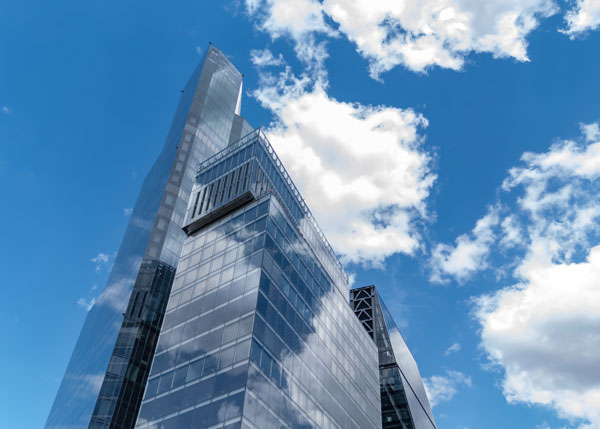
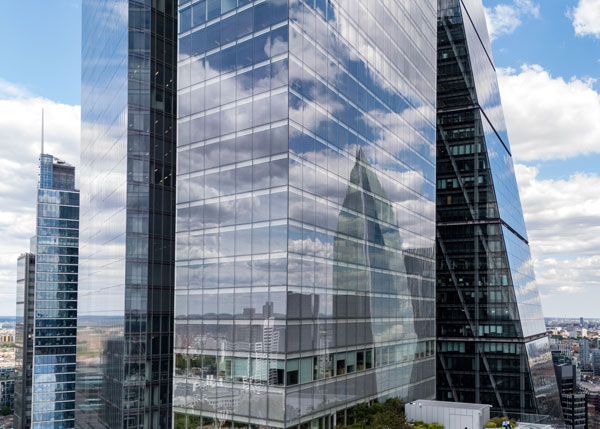
Located in the heart of London’s financial district, 8 Bishopsgate is a 51-storey commercial tower reaching approximately 204 m in height. The building was designed by WilkinsonEyre with structural and services engineering by Arup and construction managed by Lendlease. The building comprises approximately 52,900 m² of high-grade office space, along with retail and amenity areas. Its form is expressed as a series of stacked shapes that step back as the height increases, creating terraces at several levels and culminating in a pavilion block at the top which houses plant, executive space and a public viewing gallery.
Structurally, 8 Bishopsgate uses a steel-frame superstructure supported by two concrete cores that provide the lateral stability. The floor systems use composite metal-deck slabs, and the façade is a double-skin glazed system incorporating interstitial blinds designed to reduce solar gain and improve energy efficiency. From a sustainability and amenities perspective the building is impressive: it was delivered to BREEAM Outstanding and EPC A targets. A key public amenity is the free 50th-floor “Lookout” viewpoint for visitors,this public viewing gallery has magnificent views across London.
Sustainability has been a key design driver from the project’s inception. The structure uses only the steel needed for each load, reducing total steel by 25% and saving around 5,000 tonnes of CO₂. A raft foundation cuts the number of piles, saving 3,000 m³ of concrete (about 300 tonnes of CO₂). The tower’s massing is carefully composed: each block is slightly rotated and cantilevered to create a dynamic stacked form that reduces visual bulk and relates to the varied surrounding townscape.
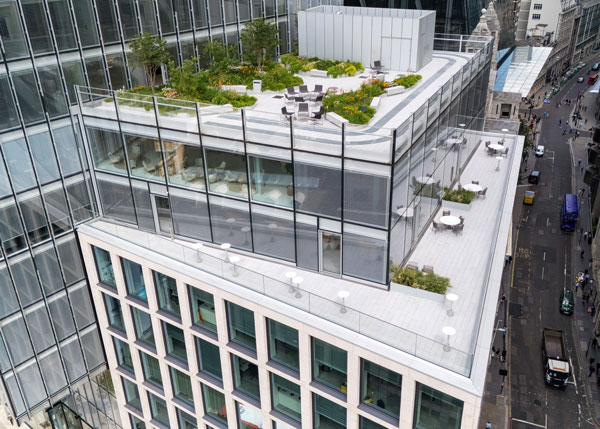
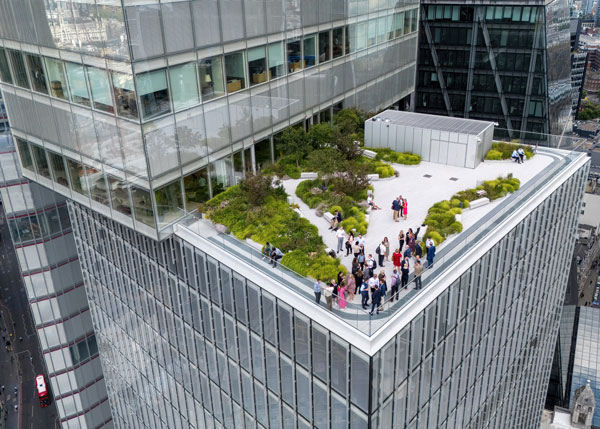
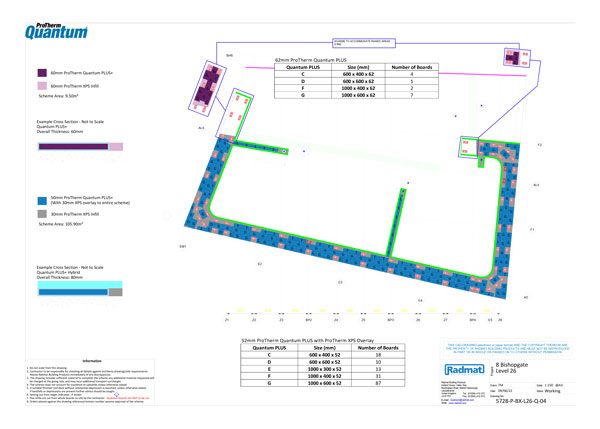
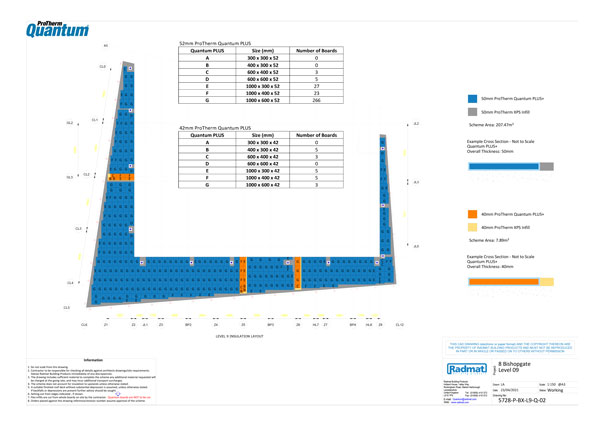
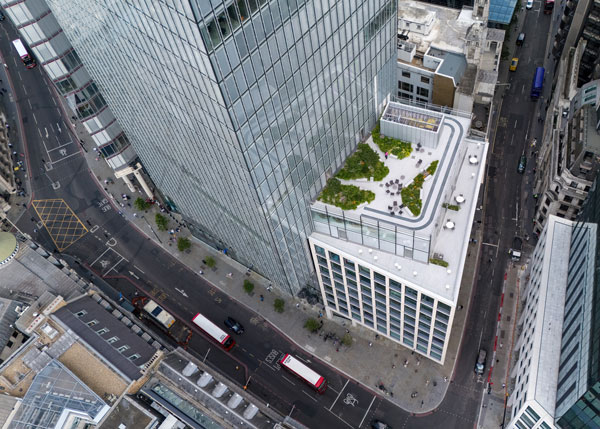
In the roof and upper plant zone, the pavilion block at the top accommodates major building services, including mechanical and electrical plant, and makes provision for photovoltaic panels and louvres to support the building’s carbon-reduction goals. As the tower’s stacked massing recedes at higher levels, it creates opportunities for a series of generous roof terraces at levels 9, 11, 25 and 26. These elevated external platforms provide valuable amenity space for building occupants, incorporating a combination of hard and soft landscaping to support both social use and visual interest. The terraces offer welcome access to fresh air and daylight within a dense urban context and afford expansive views across the City of London, contributing positively to workplace wellbeing and the overall tenant experience.
Radmat’s products largely contributed to the environmental savings for the roof and terraces. The use of state-of-the-art ProTherm Quantum Plus+ VIP system can reduce the thickness of inverted roofing systems without compromising thermal performance, whilst still achieving level thresholds.
The U-value was kept to an overall 0.25 W/m•K despite some of the features on the roofs making this difficult to achieve. ProTherm Quantum and XPS Infill insulation was used extensively on roof areas that required irregular shapes and keeping to a low height under the BMU track and plant machinery.
Radmat’s Blue Roof system was also a major factor in keeping to sustainability targets. Rainwater in an inner city or urban location provides a greater challenge, particularly on constrained sites such as in urbanised areas, or brownfield sites, where the use of underground tanks are difficult and/or costly.
The Radmat Blue Roofing system is explicitly designed to attenuate rainwater rather than drain as quickly as possible, significantly contributing to the SuDS requirements within a development by collecting and temporarily retaining rainfall (for a maximum of 24 hours) within the roof finishes before discharging at a controlled rate.
Radmat’s Blue Roof system consists of PermaQuik Hot Melt Monotlithic Membrane and EshaFlex 370 Reinforced Bitumen Membrane, guaranteeing the six Blue Roof levels at 8 Bishopsgate are completely leak free for the design life of the building.
Overall, 8 Bishopsgate demonstrates how a modern high-rise office tower in central London can integrate premium working environments, public amenity, sustainability standards and architectural distinction. Its stepped massing, generous tenant amenities, high-capacity active-travel facilities and the pavilion viewing gallery reflect evolving expectations in commercial tower design. The roof and plant zone reiforce how “the roof” in such buildings is not merely a cap but a critical performance zone, combining structural, mechanical, façade and amenity disciplines at height. The project offers useful lessons in early multidisciplinary coordination, flexibility in plant layout and the importance of detailed focus on high-level structural/maintenance zones, Radmat’s premium ProTherm Quantum Plus+ and Blue Roof systems ensure the integrity of these roofs for many years to come.


